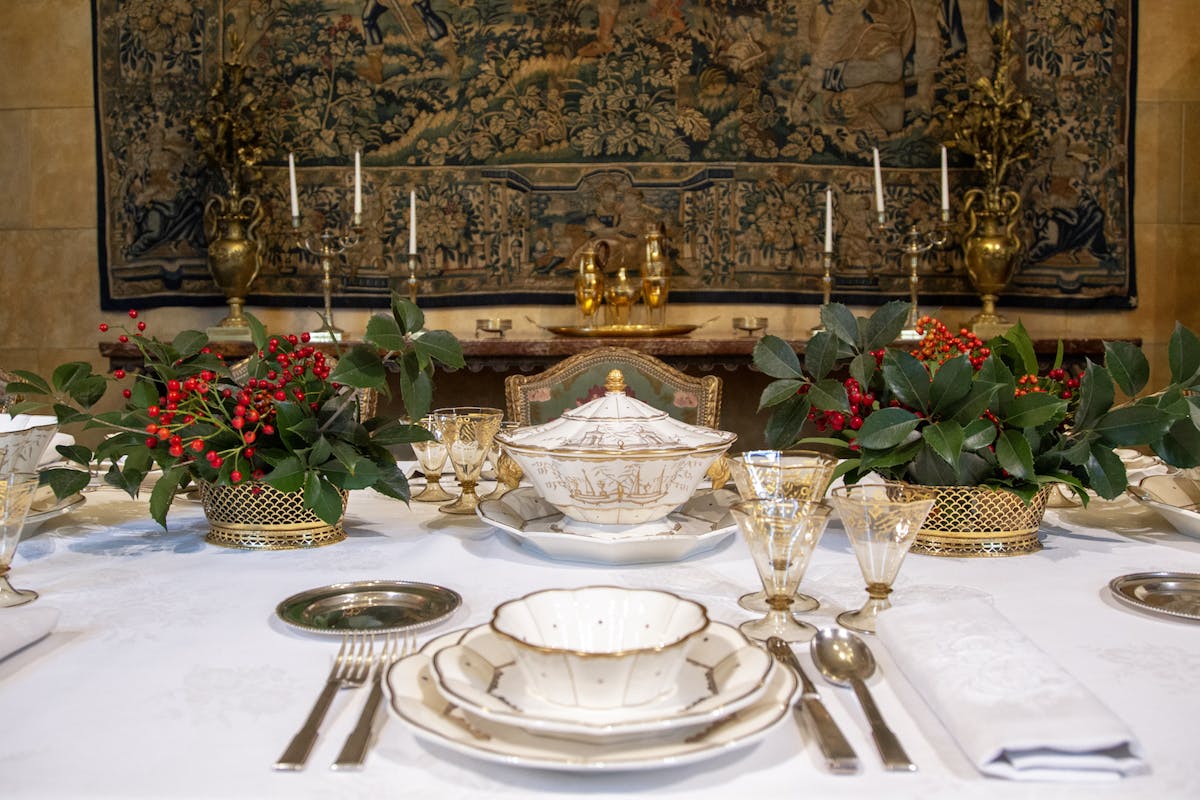
The Christmas table at Villa Necchi designed by Guido Andloviz
10 dicembre 2025
In 1856, three former employees of the Richard factory in Milan founded a manufacturing company that was destined to become a cultural excellence: the Società Ceramica Italiana (S.C.I.) in Laveno (Varese). After an intense period of large-scale production of earthenware and valuable Art Nouveau objects, in the 1920s, the young Guido Andloviz (Trieste, 1900 – Grado, 1971), a pupil of Piero Portaluppi at the Brera Academy of Fine Arts, became its artistic director and gave the production a decidedly modern character, making the factory highly competitive with established companies such as Gio Ponti's Richard-Ginori.
It was in this context that the precious beige and gold tableware designed by Andloviz around 1925 for S.C.I. was created. FAI displays it in the dining room of Villa Necchi in Milan, on a table set for the Christmas holidays, thus giving the tableware its rightful context and taking the opportunity to reaffirm the character and domestic atmosphere of this property.
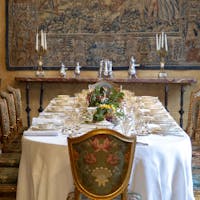
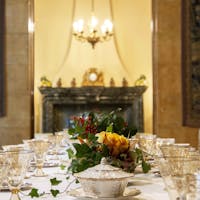

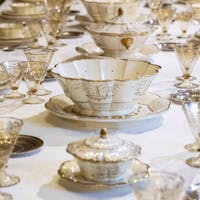
The tableware on display, from a private collection (courtesy Saverio Di Giaimo, Napoli), made of glazed ceramic, model 'Monza 16' with the '1170' decoration, consists of a soup tureen, three bowls, six terrines, four ladles, thirty-two serving plates, twenty-three small cups, sixty-nine knife plates, twenty-three soup plates and seventy-two fruit plates. At Villa Necchi, the table is set for 12, alongside silver cutlery and Murano glass glasses with gold rims and geometric decorations from the household service. The table will also be set with an elegant Flanders tablecloth belonging to the Necchi family and a large centrepiece decorated with flowers and leaves from the Villa's garden.
The "Monza 16" service stands out for its slightly wavy profile and elegant oriental decoration featuring minimalist architecture and landscapes, which reflect modern taste and classic form in a sophisticated synthesis. The model can be found in important public collections, with variations preserved at the Wolfsoniana in Genoa and the Museum of Ceramic Design in Laveno-Mombello.
Andloviz was the first in-house designer at a company, already committed in 1925 to presenting finely decorated pieces at the Monza Biennale – such as this one on display at Villa Necchi – created using innovative techniques. At the Third Monza Biennale in 1927, critics stated that "under the youthful guidance of architect Guido Andloviz... there is more life, more free spirit, more youth".
Andloviz preferred simplicity to the descriptive opulence of classicism. His artistic production is characterised by the purity of its more square and linear forms, combined with a modern vision of line and colour. This creative approach, between decoration and colour, oriented towards the essential, identified his style throughout his career.
If you liked this article read these
Regalati 365 giorni di arte e cultura nell'Italia più bella, risparmiando.
Ingresso gratuito
nei Beni FAI tutto l'anno
Gratis
