Italy on Film: FAI properties between cinema and real landscapes
21 maggio 2026
FAI properties are not mere locations: they are authentic spaces, inhabited by history and beauty, which Italian and international directors have chosen and continue to favour to bring their stories to life.
Milan and an Elegance That Becomes Narrative
In the heart of Milan, the refined Villa Necchi Campiglio is one of the most iconic places in contemporary cinema. In Luca Guadagnino's I Am Love, the villa becomes an emotional extension of the characters, with its rigorous spaces and suspended stillness. In Ridley Scott's House of Gucci, it embodies the elegance and complexity of Milan's world of fashion and power, helping to construct an image of Italy that is immediately recognisable on an international level.
Among the directors who have known how to bring out its atmosphere, Guadagnino transforms it into a true character in the film – a living symbol of the story's tensions and emotions – while Ridley Scott uses it to evoke the Gucci world, caught between luxury, identity and contradiction.
Villa Necchi Campiglio – Milan
Lake Como: One of World Cinema's Iconic Settings
Overlooking the unique scenery of Lake Como, the magnificent Villa del Balbianello is one of the Italian locations most beloved by international cinema. Its terraces suspended over the water have become legendary: they appear in Star Wars: Episode II – Attack of the Clones, where they become the romantic planet Naboo, and in James Bond – Casino Royale, where they host one of the saga's most elegant sequences. In 2002 the villa served as the setting for Anakin and Padmé's wedding, while in the 2006 Bond film it is transformed into a refined clinic nestled in nature.
A place capable of adapting to different genres – from fantasy to thriller, from romance to action — while always maintaining a strong cinematic identity.
Villa del Balbianello – Lake Como
Venice and the North: between architecture and cinematic imagination
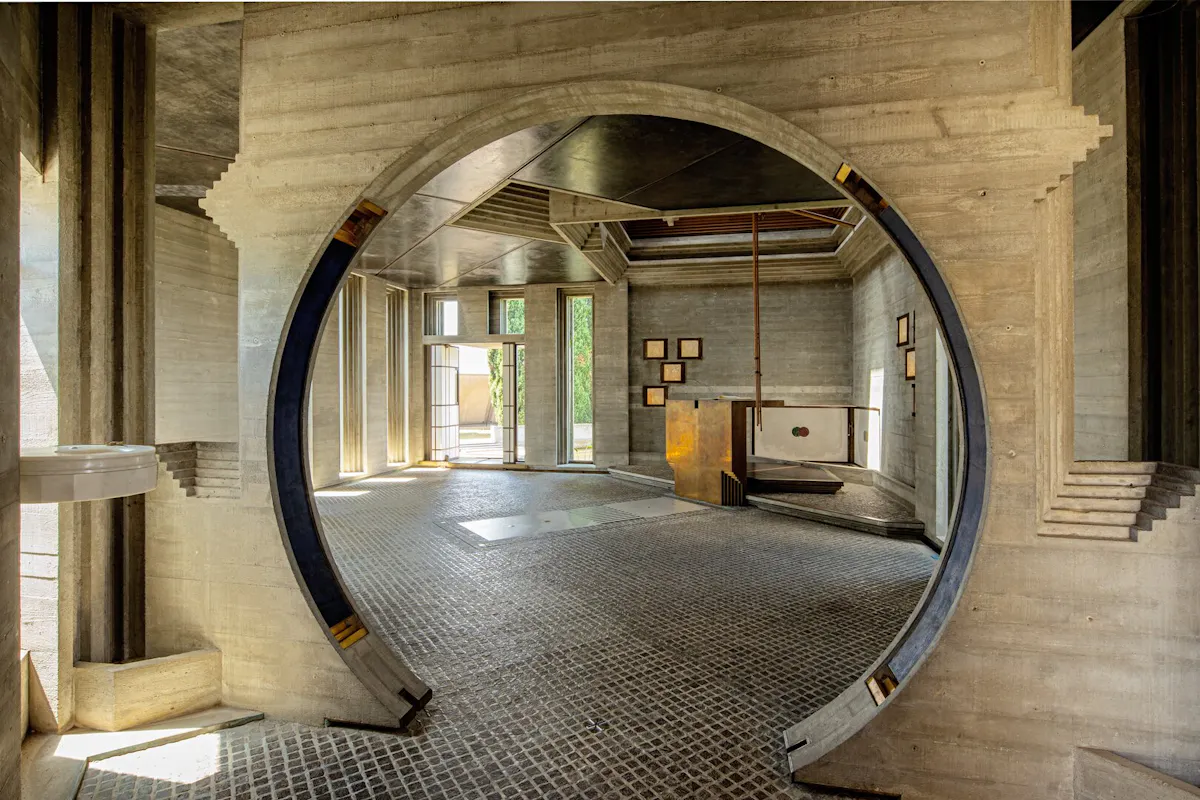
Moving into the Veneto, the language of cinema encounters one of the twentieth century's most extraordinary works of architecture: the Memoriale Brion, a masterpiece by Carlo Scarpa. Its geometry, suspended between spirituality and formal rigour, has attracted international productions, eventually entering the visual imagination of Dune – Part Two, confirming its highly cinematic power. A place that seems to belong to a future frozen in time, perfectly suited to complex and visually powerful narrative universes. It was also the filming location for Francesco Sossai's Le città di pianura, a film that this year won eight David di Donatello awards — the highest accolade in Italian cinema.
In Venice, the Negozio Olivetti demonstrates how architecture can become cinematic storytelling. Designed by Carlo Scarpa and overlooking Piazza San Marco, it has featured in visual projects and documentaries exploring the dialogue between design, memory and narrative.
In the Euganean Hills, the elegant Villa dei Vescovi represents a rare example of Renaissance architecture set within the landscape. While it does not yet have an extensive cinematic history, it has been considered on several occasions by international productions, including The New Pope, confirming its great scenic potential.
Memoriale Brion – Veneto
Southern Italy: light, history and authenticity
In Puglia, the Abbazia di Santa Maria di Cerrate was chosen as a location for the international series Briganti, set in nineteenth-century Italy. Here the landscape is not a simple backdrop, but an essential narrative element: the stone, the light and the silence build an atmosphere that is authentic and deeply cinematic, increasingly appreciated by global productions.
Abbazia di Santa Maria di Cerrate – Puglia, Lecce
From elegant Milan to Lake Como, from Venice to Puglia, FAI properties demonstrate that Italy's cultural heritage is not only to be preserved, but to be lived and told.
These places represent something unique: the opportunity to film in real spaces where history, beauty and cinema already exist — with no need for reconstruction.
Discover the FAI properties that have become film sets
If you liked this article, read it here
Regalati 365 giorni di arte e cultura nell'Italia più bella, risparmiando.
Ingresso gratuito
nei Beni FAI tutto l'anno
Gratis
